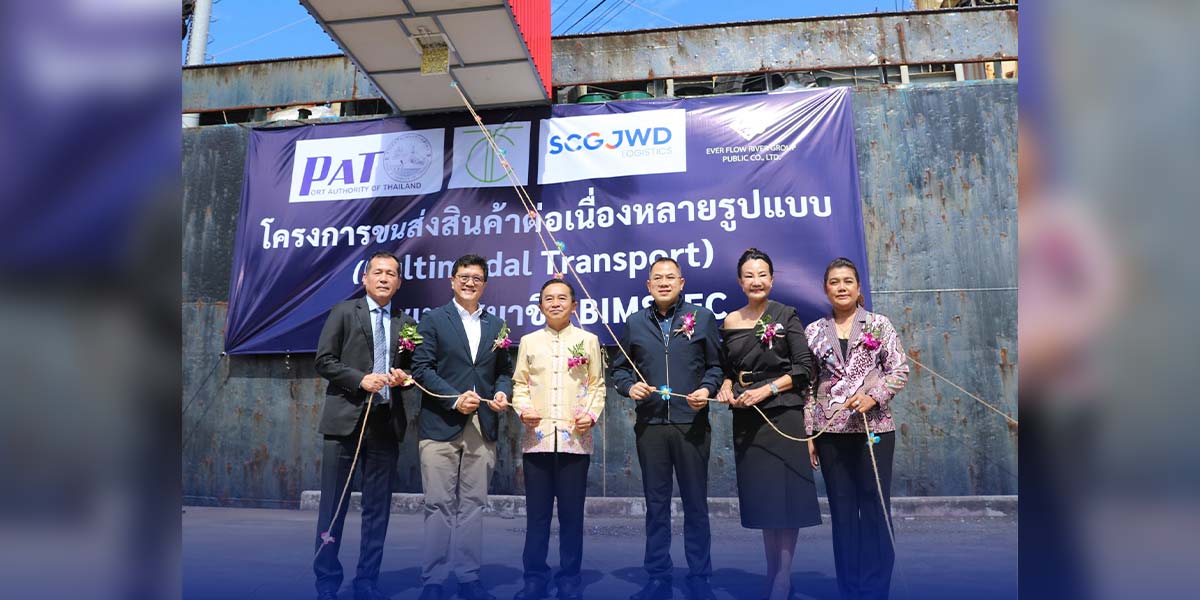

The Port Authority of Thailand (PAT) has officially launched a new multimodal transport route from Ranong Port, marking the first shipment connecting Lao PDR, China, Thailand, Myanmar, and BIMSTEC countries. The inaugural service, which began on September 23, 2025, departed for Yangon Port, Myanmar. This initiative combines truck, rail, and sea transportation to create seamless logistics connectivity, positioning Ranong Port as a strategic gateway to ASEAN and South Asia. PAT also announced plans to upgrade port infrastructure, including crane repairs, as it forecasts a THB 5 million profit this year after two decades of losses.

PAT Director Kriengkrai Chaisiriwongsuk stated that Ranong Port is ready to serve as Thailand’s western gateway to BIMSTEC. The new multimodal transport project is a collaboration with Thai Transport Center Co., Ltd. (TTC) and partners such as SCGJWD Logistics Plc., Myanmar’s Ever Flow River Group Plc., and SPT Smart Creation Co., Ltd. Unlike previous bulk cargo handling, this initiative focuses on containerized cargo, linking southern China with Myanmar and BIMSTEC nations. Transit times are significantly shortened: three days to Yangon, four days to Chittagong (Bangladesh), and six days to Chennai (India) and Colombo (Sri Lanka), compared to the usual 14–21 days.

BIMSTEC (Bangladesh, Bhutan, India, Myanmar, Nepal, Sri Lanka, and Thailand) represents a high-potential market with a combined population of over 2 billion. PAT expects the new service to enhance trade continuity, reduce costs, and attract more cargo flows through Ranong Port. In addition, Ranong is being positioned as a policy and operational sandbox for Thailand’s Land Bridge project, testing logistics systems including multimodal integration, customs procedures, and green port models.
Operational results for fiscal year 2025 show Ranong Port handled 6,300 TEUs, 186,000 tons of cargo, and 235 vessel calls over 11 months. Full-year projections estimate 6,400 TEUs (up 140%) and 196,000 tons (down 39%), with profits expected at THB 5 million, compared to THB 300,000 last year—the first positive results since PAT took over the port in 2003.

Currently, Ranong Port has two berths: a 134-meter multipurpose berth for vessels up to 500 GRT and a 150-meter container berth for vessels up to 12,000 DWT. It also has a 120-meter-wide, 8-meter-deep channel extending 28 kilometers, as well as more than 36,000 square meters of storage, capable of holding 648 TEUs. Due to physical constraints of the terminal area and seabed conditions, the effective capacity is around 35,000 TEUs, about 40% of its designed capacity of 78,000 TEUs. PAT is budgeting THB 30 million for 2026 to repair mobile cranes and lease additional lifting equipment to reduce private operators’ costs.

Private sector partners are optimistic. Nattha Thanakitsathaporn, CEO of Thai Transport Center Co., Ltd., said phase one involves shipments to Myanmar and Bangladesh twice monthly, with plans to expand to weekly services by mid-2026. With a fleet of five vessels (three owned, two partner vessels), each voyage can carry 70–80 containers, equivalent to construction goods valued at THB 30–50 million per trip. Longer-term plans aim to connect four major BIMSTEC ports—Yangon, Chittagong, Chennai, and Colombo—generating monthly trade worth billions of baht.

Nattapoom Paowarat, Senior Director of Business Development at SCGJWD Logistics Plc., added that Ranong’s gateway role is supported by cooperation from customs authorities, industry chambers, and trade groups in BIMSTEC and Indochina. The port’s growth will boost investor confidence in Thailand’s logistics base and stimulate Ranong’s local economy, including seafood processing industries, job creation, and wider infrastructure development.

With its shorter transit times, niche positioning, and alignment with the Land Bridge strategy, Ranong Port is on track to become a crucial logistics and trade hub bridging ASEAN and South Asia.
Photos and news article from https://mgronline.com/business/detail/9680000091107 (September 23rd, 2025)