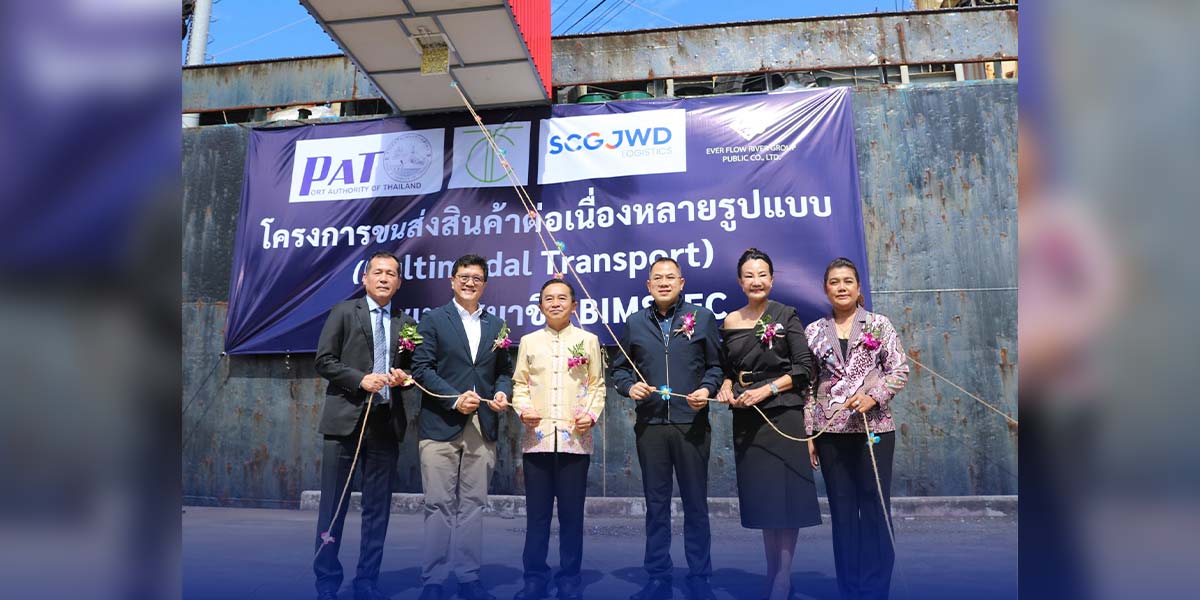

On September 23, at Ranong Port, Mr. Kriangkrai Chaiyasirivongsuk, Director of the Port Authority of Thailand (PAT), announced the official launch of the Multimodal Transport Project linking China–Lao PDR–Thailand–Myanmar and the BIMSTEC countries (Thailand, India, Myanmar, Sri Lanka, Bangladesh, Bhutan, and Nepal).
The project aims to promote an integrated transport corridor that seamlessly connects road, rail, and maritime logistics while positioning Ranong Port as a key economic bridge between Southeast Asia and BIMSTEC, a region of over 2 billion people. This development is expected to boost the port’s competitiveness, generate additional revenue for PAT, and support handling capacity of up to 30,000 containers annually.

The initiative is a public–private partnership led by Thai Transport Center Co., Ltd., in collaboration with SCG JWD Logistics Plc., Ever Flow River Group Public Co., Ltd. (Myanmar), and SPT Smart Creation Co., Ltd. The partners will consolidate import–export cargo into single shipments, reducing transport costs and increasing throughput at Ranong Port.

The inaugural voyage carried cargo from Ranong Port to Yangon Port, Myanmar, operating initially at two round trips per month before scaling up to one per week. By mid-2026, routes will expand to Bangladesh and India. This marks a significant step toward elevating Ranong Port as Thailand’s “Gateway to the Andaman,” enabling faster, more efficient access for goods from southern China, Lao PDR, and Thailand to the BIMSTEC market.

Mr. Kriangkrai highlighted that Ranong Port is the only state-owned port on the Andaman coast and will serve as a “sandbox” for the government’s 900-billion-baht Land Bridge megaproject. The project will integrate multimodal transport systems, digital platforms, and customs processes. Cargo from southern China can reach Ranong Port in just 2–3 days via direct road or rail–road connections through Lao PDR and Chumphon, compared to over three weeks by sea through the congested Strait of Malacca.

Transport times have been dramatically reduced under the new route: three days to Yangon (down from 12 days via Laem Chabang), four days to Chittagong, Bangladesh (previously 13–15 days), five days to Chennai, India, and seven days to Colombo, Sri Lanka (previously 14–21 days). These improvements enhance competitiveness for both Thai and international businesses by lowering costs and shortening delivery cycles.

Ranong Port, located along the Kra Buri River, about 28 kilometers inland from the Andaman Sea, currently has an 8-meter channel depth suitable for vessels carrying 50–120 containers. The upcoming Land Bridge project will add a deep-sea port in Ranong with a 14-meter depth, capable of handling 3,000–20,000 TEU vessels. Mr. Kriangkrai stressed that the Land Bridge will not compete with Ranong Port; instead, the two facilities—located 60 kilometers apart—will complement each other, boosting trade activity and enhancing Thailand’s position as a global logistics hub. Together, they will provide a strategic alternative shipping route that bypasses the crowded Strait of Malacca, strengthening Thailand’s role in regional and international supply chains.
Photos and news article from https://www.dailynews.co.th/news/5139699/ (September 23rd, 2025)